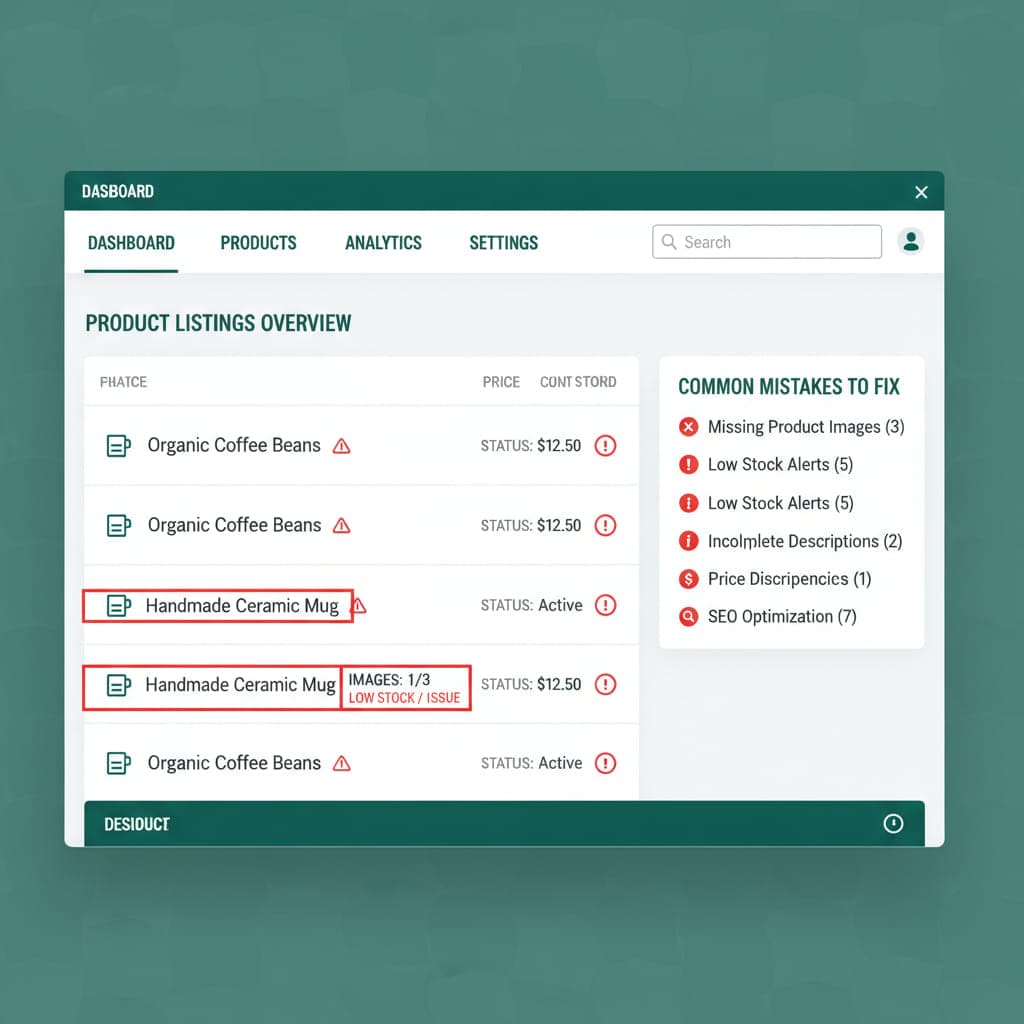
How to Sell on Vinted with AI: 2026 Guide to Listing 50 Items a Week Without Losing Your Mind
Vinted's published ranking parameters, listing limits (20 photos, 3 materials, 5 items per set) and fees, plus a measured AI workflow from photo to listing.
Vinted AI: from 50 items piling up in your wardrobe to listings ready to publish
Selling on Vinted with AI means using image-based cataloging powered by artificial intelligence so that AI does most of the writing while you review: title, description, brand, size, and hashtags generated automatically from a single photo. In 2026, this is the decisive advantage for anyone looking to scale from a hobby into a small reselling business, without spending every evening copy-pasting data.
Vinted in numbers: the official figures
Vinted Group published its 2025 annual results on 9 April 2026. Members traded 10.8 billion euros of goods on the marketplace in 2025, up 47% on 2024 (7.3 billion); the group made 1.1 billion euros of revenue, up 38%, and a net profit of 62 million euros. In 2025 Vinted also launched in Latvia, Estonia and Slovenia. Under the EU Digital Services Act, Vinted reports an average of 29.3 million monthly active recipients in its ten connected EU markets (France, the Netherlands, Belgium, Luxembourg, Spain, Italy, Portugal, Ireland, Austria and Germany) as of 31 January 2026. Sources: Vinted Group, 2025 results and Vinted, Our platform, both checked on 21 September 2026.
For a seller those numbers mean one thing. A marketplace this large is crowded, so complete, recent, photo-rich listings are what makes an item findable, and sellers who do everything by hand struggle to keep up.
Who sells on Vinted in 2026: 4 personas
The average Vinted seller in 2026 is no longer just a student clearing out their wardrobe. There are four distinct profiles: the stay-at-home parent reselling part-time, the university student funding their studies, the professional reseller with 500+ items in stock, and the second-hand brand with a warehouse. Each has different needs but shares one common problem: cataloging time.
- Part-time stay-at-home seller: 10 to 20 listings per month, limited time, convenience is the priority. AI gets items published quickly while they focus on other things.
- University student: 30 to 60 items per month, tight budget, wants to maximize return per item. AI helps write titles and hashtags that say precisely what the item is.
- Professional reseller: 150 to 300 items per month, catalog managed like an inventory. AI is essential for scaling without hiring extra staff.
- Second-hand brand: 500+ items per month, team of 2 to 4 people. AI frees the team from data entry so they can focus on curation and marketing.
Why the product listing makes all the difference on Vinted
Vinted publishes the parameters its recommender systems use to select and rank listings in the newsfeed and in search results, as required by the EU Digital Services Act. Its help page "Recommended content on Vinted", checked on 21 September 2026, lists them: time since the item was uploaded; the number of interactions the item has already collected (impressions, favourites, clicks); the item's and the buyer's country; the lister's and the buyer's preferred language; the item price; the item ontology, meaning category, brand, size, colour, listing photos and other attributes; the item condition; listing frequency, so that a seller who uploads many items in a short time is shown to buyers proportionately; seller type, regular or Pro; the filters and search query expressed by the buyer; the item description, used to evaluate relevance to the query; image resemblance when a buyer searches by image; the buyer's own history and following list. Vinted adds that it promotes some segments, such as new listings and paid Bumps, and that the most important factors are the filters applied by the member and by the system, promoted content, and item attractiveness criteria, namely recency, number of interactions, price and condition.
Vinted lists the parameters, not their weights, and says priorities vary by use case. What a seller controls is clear anyway: the fields that feed the ontology (category, brand, size, colour, photos), the condition, a description that matches what buyers type, the price, and recency. A listing with a generic title, a thin description or a missing size gives buyers and the ranking less to work with. This is why AI image-based cataloging is not a luxury gadget: it fills those fields from the photo and the label, and you check them. Source: Recommended content on Vinted.
The 5 pillars of an optimized Vinted listing
- Descriptive title: brand, category, colour and size, with the specific details Vinted itself recommends. Its help page "Describing an item" gives the title to prefer, "New pink Zara mini evening dress", the one to avoid, "Very nice dress", and asks sellers to skip words such as "nice", "pretty" or "good" that do not say how the item is different.
- Detailed description: the same page asks for the item's measurements, any materials beyond the three you can select in the upload form, alterations such as repairs or tailoring, a missing brand label, and every flaw (marks, stains, holes, pilling), which must also be visible in the photos. Do not mention or hashtag any brand other than the one selected in the brand field.
- Official brand: selected from Vinted's list, with "No brand" available for unbranded items. Vinted's catalogue rules forbid unrelated brands in the brand field, title, description or hashtags, and the words "inspired by" followed by a brand. When the label is visible, AI reads it and suggests the correct brand.
- Size with measurements: beyond the nominal size, add measurements in cm yourself, since the AI does not guess them from the photo and Vinted asks for them in the description.
- Hashtags: relevant and non-duplicate, never for other brands. AI generates a mix of generic (#vintage, #casual) and specific (#greysweatshirt, #nikewomens) tags for you to trim.
Limits and rules of the Vinted upload form, from the help centre and the catalogue rules, checked on 21 September 2026:
- Photos: up to 20 per listing, taken by you (no stock photos, no editing), sharp, in natural daylight without flash or filters, from several angles; the first photo must show the whole item.
- Materials: up to 3 in the upload form, the others in the description.
- Condition: five levels with official definitions, New, Like new, Very good, Good and Satisfactory, plus Needs repair for electronic devices only. A condition worse than described can lead to a cancelled order, and a wrong condition can get the listing hidden.
- Sets: up to 5 items in one set listing, which must say it is a set in the title or description, with one photo showing all the items; buyers can also bundle up to 100 items from your listings in a single order.
- Bumps: a paid Bump shows the item higher in the newsfeed and in search results for 3 or 7 consecutive days, or until it sells.
Sources: What photos you should upload, Describing an item, Choosing item condition, Selling multiple items as a set, Uploading step by step, Additional services to boost your listings and the Catalog rules.
What Vinted charges and what you keep
Selling is free. Vinted's help centre says there are no fees to upload or sell items, and the seller receives the full sale price in the Vinted balance once the sale is complete. The buyer pays a Buyer Protection fee on every order, added automatically at checkout: on the Italian site the fee is described as usually 5% of the item or set price plus 0,70 euro, and it varies with the order value and type, so check the help page of your own market. Paid visibility, the Bumps, is optional and its price is shown at checkout. Sources: Vendere su Vinted è gratuito? and Commissione per la Protezione acquisti, checked on 21 September 2026.
In practice, the price you write is the price you receive, and the buyer sees your price plus the fee. Worth remembering when AI drafts a listing and you set the price by hand.
How AI takes over most of the writing
The classic manual workflow on Vinted has several steps for every listing: taking photos, editing light and background, writing the title, description, and tags, and selecting brand, size, and condition. With AI image-based cataloging, AI does most of the writing and you review the result.
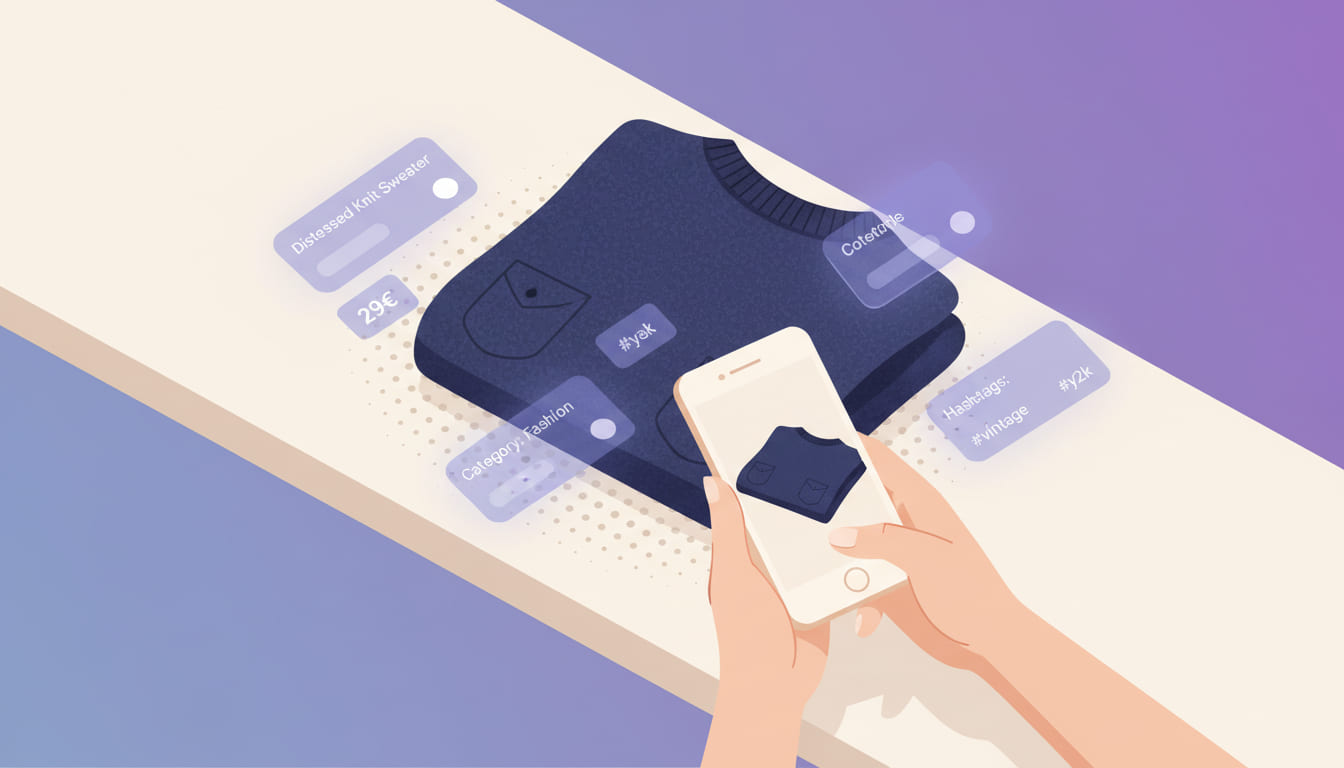
Here's how: you take the photo, upload it to Katapic, and the AI reads the photo and the label, extracts brand, category, color, size, and material when they are visible, and writes a title and a description. You review, adjust any fields if needed, set the price, and publish.
What that takes in practice, measured on Katapic's own logs: on 669 photo readings between 3 July and 21 September 2026, the model's reading of a photo and first draft took a median of 12 seconds, and nine out of ten were done within 22 seconds. When several photos are uploaded together, half the items were ready within a minute and nine out of ten within three minutes, queue time included, on the 304 items completed in the 90 days to 21 September 2026. Your own review time is not included, and the draft is only as good as the label and the photo.
Practical workflow: from photo to listing
A concrete example: you photograph a tailored blazer with your smartphone and upload it. The AI identifies a women's wool blazer, size 42, navy, and reads the brand from the label. It writes a title such as "Max Mara wool blazer 42", a description with the composition for you to check, and hashtags. You add the measurements in cm, check the details, set the price, and publish.
Mistakes to avoid even with AI
AI drastically reduces errors but doesn't eliminate them entirely. Five typical mistakes the seller still needs to check manually: blurry or underexposed photos (AI can't fix bad photography, and if the photo is poor the listing suffers), incorrect brand when the label is torn, foreign sizes converted incorrectly (US vs EU vs UK), price set too high or too low for the local market, hashtags too generic in saturated categories.
The recommended workflow is: AI handles the repetitive part, you check what matters. This way, time stays low but quality stays high.
Vinted AI FAQ
How do I publish to Vinted with Katapic?Katapic generates listings ready for Vinted that you can copy in seconds: optimized text (title, description, size, hashtags) plus downloadable image. Publishing to Vinted remains manual via the Vinted app or website.
How does Vinted decide which listings to show?Vinted publishes the parameters of its recommender systems (recency, interactions, country, language, price, item ontology, condition, listing frequency, seller type, filters and query, description, image resemblance, buyer history) and names filters, promoted content and item attractiveness as the most important ones. It does not publish the weights.
How many photos can I add and what does Vinted charge?Up to 20 photos per listing. Selling is free for the seller, who receives the full price; the buyer pays a Buyer Protection fee on every order, described on the Italian site as usually 5% plus 0,70 euro.
Can I use Katapic for Depop, Wallapop, and eBay too?For eBay, yes: Katapic writes the text following eBay's length and format rules, as it does for Vinted. Depop and Wallapop have no specific rules in Katapic: you can copy the title and description there, but they are not written to those platforms' formats.
How much does it cost to try?You start with a one-time free trial, with no card required; the current number of free credits is on the pricing page. After that, you buy credit packs only when you need them: nothing renews and credits never expire.
Does AI suggest a price?No. Katapic reads a price only if it is visible in the photo; otherwise, you set it yourself before publishing.
Does it only work in Italian?The AI copywriter writes listings in 10 languages.
Vinted names the item's brand, category, size, colour and photos among the parameters of its recommender system, and its catalogue rules forbid unrelated brands in the brand field, the title or the hashtags. Put the exact brand in the title and in the brand field; when the label is visible, the AI reads it for you.
Next steps: try the workflow
To get started with AI-powered Vinted selling, we recommend 3 concrete moves. First, create a free account and upload 2 items for free to test the workflow. Second, compare manual time vs AI time across 5 listings, since measuring is the only way to understand the real time savings. Third, explore the 7 fatal product listing mistakes, the photo to listing guide, and AI image editing if you work with flat-lay or warehouse photos.
One final recommended read: the complete guide to AI image-based cataloging 2026, with more detail on how the AI reads the photo and the label, useful if you want to understand exactly what happens when you upload a photo.
Frequently asked questions
- How does AI reduce the time it takes to create a Vinted listing?
- The AI reads the photo and the label, extracts brand, category, color, size, and material when they are visible, then drafts a title, a description, and hashtags. On 669 photo readings between 3 July and 21 September 2026 on Katapic, the reading and first draft took a median of 12 seconds; you then review the details, add measurements, set the price and publish.
- What are the most important elements of an optimized Vinted listing?
- A title with brand, category, colour and size (Vinted's own example: "New pink Zara mini evening dress", not "Very nice dress"), a description with measurements, materials beyond the three selectable in the form, alterations and flaws, the official brand from Vinted's list, the right condition among the official levels, and relevant hashtags with no other brand names.
- What mistakes should sellers still check manually even when using AI cataloging?
- Sellers should manually verify photo quality (AI cannot fix blurry or underexposed images), brand accuracy when labels are torn, correct size conversions between US, EU, and UK standards, appropriate local market pricing, and whether hashtags are too generic for saturated categories.
- How big is Vinted in 2026?
- Vinted Group's 2025 results, published on 9 April 2026, report 10.8 billion euros of goods traded by members (up 47% on 2024), 1.1 billion euros of revenue and 62 million euros of net profit, with launches in Latvia, Estonia and Slovenia. Under the EU Digital Services Act, Vinted reports 29.3 million average monthly active recipients in its ten connected EU markets as of 31 January 2026.
- How does Vinted decide which listings to show?
- Vinted publishes the parameters of its recommender systems: time since upload, interactions collected, item and buyer country, preferred language, price, item ontology (category, brand, size, colour, photos), condition, listing frequency, seller type, the buyer's filters and query, the description, image resemblance, and the buyer's history and following list. It names filters, promoted content and item attractiveness (recency, interactions, price, condition) as the most important factors, and does not publish the weights.
- How many photos can I add and what does Vinted charge?
- Up to 20 photos per listing, taken by you, with the first one showing the whole item. Selling is free for the seller, who receives the full sale price; the buyer pays a Buyer Protection fee on every order, described on the Italian site as usually 5% of the price plus 0,70 euro, varying with order value and type.