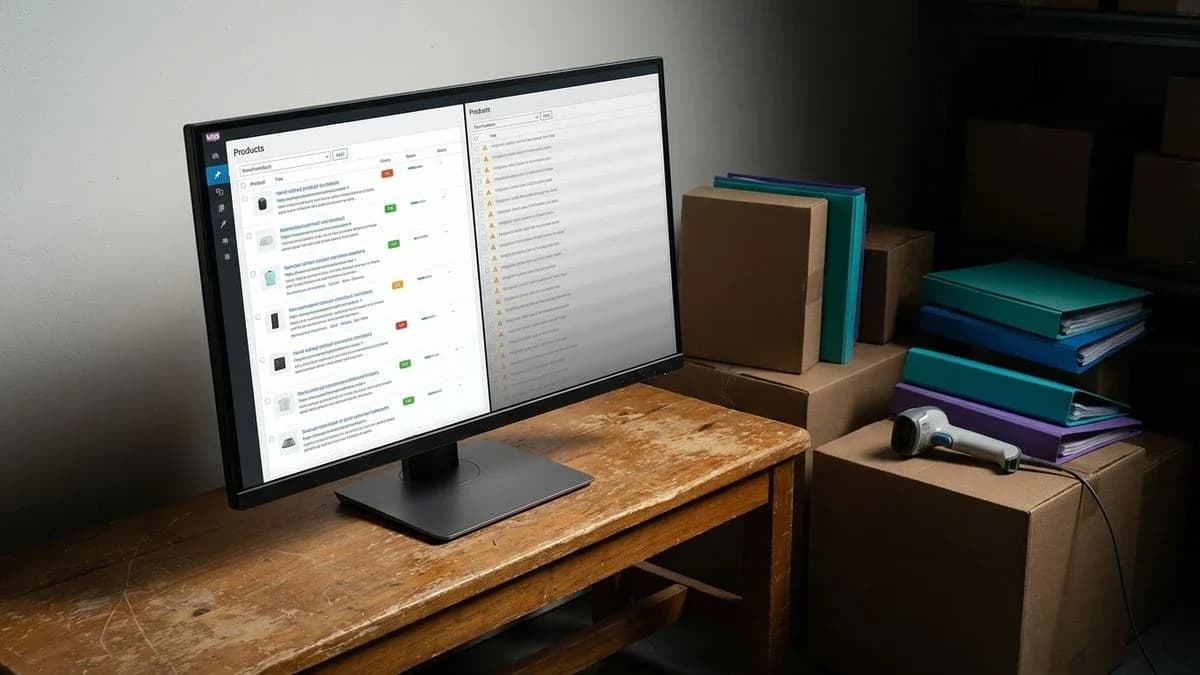
What a small retailer can realistically do to improve SEO for a WooCommerce catalog without technical skills or a dedicated team.
DIY SEO for small retailers: what to realistically expect
DIY SEO for a small retailer means the practical actions someone managing a WooCommerce catalog can take independently to improve visibility on Google: clear titles, complete descriptions, images with alternative text, and a well-organized category structure. It covers the basics, but it has a hard limit: the time available for each individual product, multiplied across hundreds of listings.
A crawler reads a product catalog one product at a time: title, description, price, availability, attributes such as color or material, and schema.org/Product markup when available. When these fields are empty or generic ("handcrafted product," "see photo"), the search engine has little information to understand what the product actually is. The same applies to AI search engines that read product pages to answer user questions. DIY SEO works when there are few products that change rarely; it starts to break down as the catalog grows or is frequently updated across multiple channels.
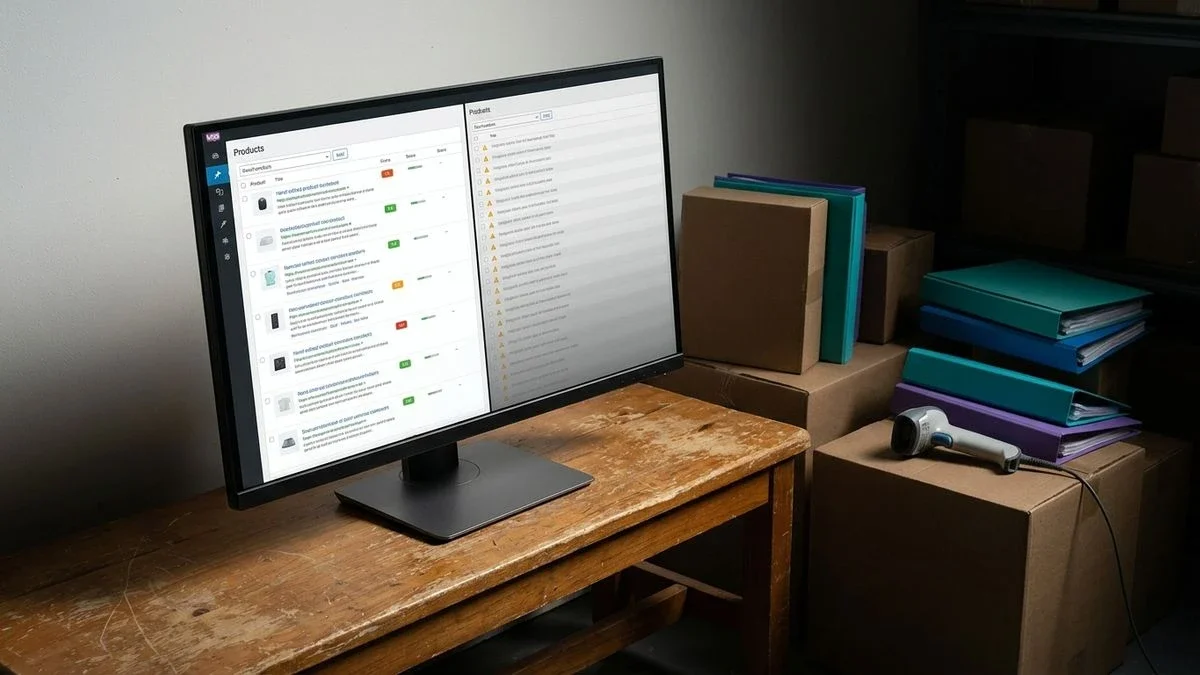
The DIY SEO challenge amid a thousand daily tasks
The main challenge is not a lack of expertise but a lack of time: every product page takes minutes, and those minutes add up across hundreds of listings.
Those selling through multiple channels, such as WooCommerce, Amazon, Etsy, eBay, and Vinted, often write the same description several times with small variations, or leave it identical everywhere and miss the opportunity to adapt it to the specific search language of each platform. The time left for SEO comes after order management, logistics, and customer service, in practice, it is limited and inconsistent.
What a small retailer can realistically do alone
A small retailer can manage product titles, descriptions, image alt text, and category structure independently, provided they set aside dedicated, recurring time.
These actions offer the highest impact-to-effort ratio because they do not require programming skills, only attention and consistency.
For those with little time for the daily routineFor anyone who opens the store in the morning and closes it at night without a break, the priority is to concentrate SEO work into one fixed weekly session instead of chasing it every day: updating ten products at a time with complete titles and descriptions is more effective than partially updating fifty.
A craftsperson selling ceramics with around forty listingsWith a catalog of this size, DIY SEO is still sustainable: a few hours a month may be enough to keep titles and descriptions up to date, as long as there is a method, not just goodwill.
Where DIY SEO reaches its limits and manual work stops scaling
DIY SEO stops working when the catalog grows beyond a few dozen products or changes frequently across several marketplaces at the same time.
Schema.org/Product markup, structured fields for price and availability, and consistency between the WooCommerce description and those on Amazon or Etsy are repetitive tasks that require precision rather than creativity. Manual work cannot scale them beyond a certain number of listings.
A catalog with inconsistent structured data is not invisible to Google or to AI assistants; what holds it back is missing, vague, or contradictory facts, in the page text and in the structured data, which leave an AI assistant less to confirm and cite in an answer.
Practical checklist: the highest-impact SEO actions without technical skills
The highest-impact actions that require no technical skills involve descriptive titles, complete descriptions, images with alt text, and well-organized categories.
- Product title including the name, material, or distinguishing feature, not just an internal code.
- A description of at least three or four sentences answering what the product is, who it is for, and how it is used.
- Descriptive, non-generic alternative text (alt text) for every image.
- Consistent categories and subcategories, without duplicates or empty labels.
- Price and availability that are always up to date and visible.
- A readable product page URL containing the product name rather than numbers alone.
Anyone operating on WooCommerce alongside Amazon, eBay, or Vinted should at least check that the product name and main characteristics are identical across all channels. Inconsistencies of this kind confuse both search engines and customers.
When to automate: is the catalog ready for Google and AI search?
A catalog is ready for automation when the number of products or the frequency of updates exceeds the capacity of weekly manual management.
There is no single threshold that applies to everyone, but there is a clear signal: if the time dedicated to SEO keeps shrinking while the catalog grows, DIY SEO is no longer scaling. At that point, it is important to understand which products are already optimized and which are not before deciding where to act.
How to tell a ready catalog from one with gapsA catalog ready for Google and AI search engines has unique titles, complete descriptions for every listing, and consistent structured data. A catalog with gaps still contains empty fields, duplicate descriptions, or missing attributes that a crawler cannot interpret.
A catalog scan should remain anonymous and read-only until the retailer consciously decides to take action.
From DIY SEO to respectful automation: where Katapic fits in
Katapic becomes part of the process when DIY SEO is no longer enough: it assigns every product four scores out of 100 (SEO, AI search, brand relevance, and completeness) without inventing specifications that are not present in the catalog.
The rewriting engine works with the retailer's real data and never fabricates content, while the initial scan remains anonymous and read-only. This allows anyone managing a WooCommerce store to see where the gaps are first and then decide whether to act. For those who want to start with a free check and understand their catalog's AEO readiness, Katapic offers a practical starting point with no registration required.
Frequently asked questions about DIY SEO for small retailers
How much time does DIY SEO take for a WooCommerce catalog?It depends on the number of products and how often they are updated. For a catalog of a few dozen stable listings, a few hours a month may be enough, while a catalog of hundreds of products that changes frequently requires a weekly commitment that is difficult to sustain without a method or support tool.
Do you need technical skills to optimize product pages?No. The highest-impact actions, descriptive titles, complete descriptions, image alt text, and consistent categories, do not require programming. They require attention, consistency, and a repeatable workflow, not developer skills.
How can I tell whether my catalog is visible on AI search engines too?A useful signal is to check whether structured product data, such as price, availability, and attributes, is present and consistent. When these facts are missing or inconsistent, in the text or in the structured data, an AI search engine has less information to cite the product in an answer.
When does it make sense to move from DIY SEO to an automated tool?When the time dedicated to SEO can no longer cover the catalog, or when products are sold across multiple channels and maintaining consistency manually becomes difficult. At that point, an objective score for each product helps identify where to act first before continuing with manual work.
Frequently asked questions
- How much time does DIY SEO take for a WooCommerce catalog?
- It depends on the number of products and how often they are updated. For a catalog of a few dozen stable listings, a few hours a month may be enough, while a catalog of hundreds of products that changes frequently requires a weekly commitment that is difficult to sustain without a method or support tool.
- Do you need technical skills to optimize product pages?
- No. The highest-impact actions, descriptive titles, complete descriptions, image alt text, and consistent categories, do not require programming. They require attention, consistency, and a repeatable workflow, not developer skills.
- How can I tell whether my catalog is visible on AI search engines too?
- A useful signal is to check whether structured product data, such as price, availability, and attributes, is present and consistent. When these facts are missing or inconsistent, in the text or in the structured data, an AI search engine has less information to cite the product in an answer.
- When does it make sense to move from DIY SEO to an automated tool?
- When the time dedicated to SEO can no longer cover the catalog, or when products are sold across multiple channels and maintaining consistency manually becomes difficult. At that point, an objective score for each product helps identify where to act first before continuing with manual work.