
WooCommerce duplicate products: six catalog checks
Six checks for SKUs, codes, titles, permalinks, photos, and variations to remove duplicate WooCommerce products without losing orders or data.
Practical guides on WooCommerce product pages, structured data, product feeds and readiness for AI search.
Six checks for SKUs, codes, titles, permalinks, photos, and variations to remove duplicate WooCommerce products without losing orders or data.

A supplier price list is not a WooCommerce catalog. Map each column to SKU, name, price, category, and attributes before importing the CSV.

Fix your WooCommerce catalog’s image sizes, duplicates, and alt text in one pass, without opening every product and without inventing data.

Five Describely alternatives for WooCommerce: what each one does, where it publishes, how it handles facts, and how to choose without taking your store offline.

Google reads files, alt text, dimensions and image_link, not how beautiful the photo is. How to align the fields of your WooCommerce catalog.

A criteria-based comparison of AI product description tools for WooCommerce: fact checking, variants, pricing model, and what happens when text fails review.

Step-by-step guide to connect WooCommerce to ChatGPT: required feed fields, onboarding, validation and common errors, explained plainly.

A fast site without complete product data struggles to stand out. Here is how Google really weighs Core Web Vitals and catalog structure.

How to compare WooCommerce, Amazon, Etsy and eBay catalogs without spreadsheets, using SEO tools designed for multichannel visibility.

Why organic traffic can drop in the fall and how to prepare your catalog, product pages, and structured data before it happens.

Real pricing ranges, what affects the cost, and how to tell whether you are paying the right amount for your WooCommerce store's SEO.

Five free signals for assessing the SEO visibility of a WooCommerce product without complex software, directly from Google.

A practical guide to knowing when DIY SEO is still enough and when your WooCommerce catalog needs a consultant or a dedicated tool.

Why hundreds of variants create duplicate content and how to structure URLs, attributes, and structured data so they can appear in Google and AI search.

Find out why Google and AI search engines can take days or weeks to index a new WooCommerce product, and what you can do to speed things up.

You do not need to optimize your entire catalog at once: here is how to choose the right products to start with and what to check on each product page.

What a small retailer can realistically do to improve SEO for a WooCommerce catalog without technical skills or a dedicated team.

There is no magic number of SEO articles per month: it depends on your catalog, visibility gap, and available time. Here is how to calculate it properly.

How to create a fact-guarded product spec sheet example without invented specifications, optimized for Google and AI search.

Five practical points to understand the difference between SEO and digital marketing and stop wasting time on your WooCommerce catalog.

The real costs, benefits and limitations of affiliate marketing for a small WooCommerce store, plus the prerequisite many overlook before launching.
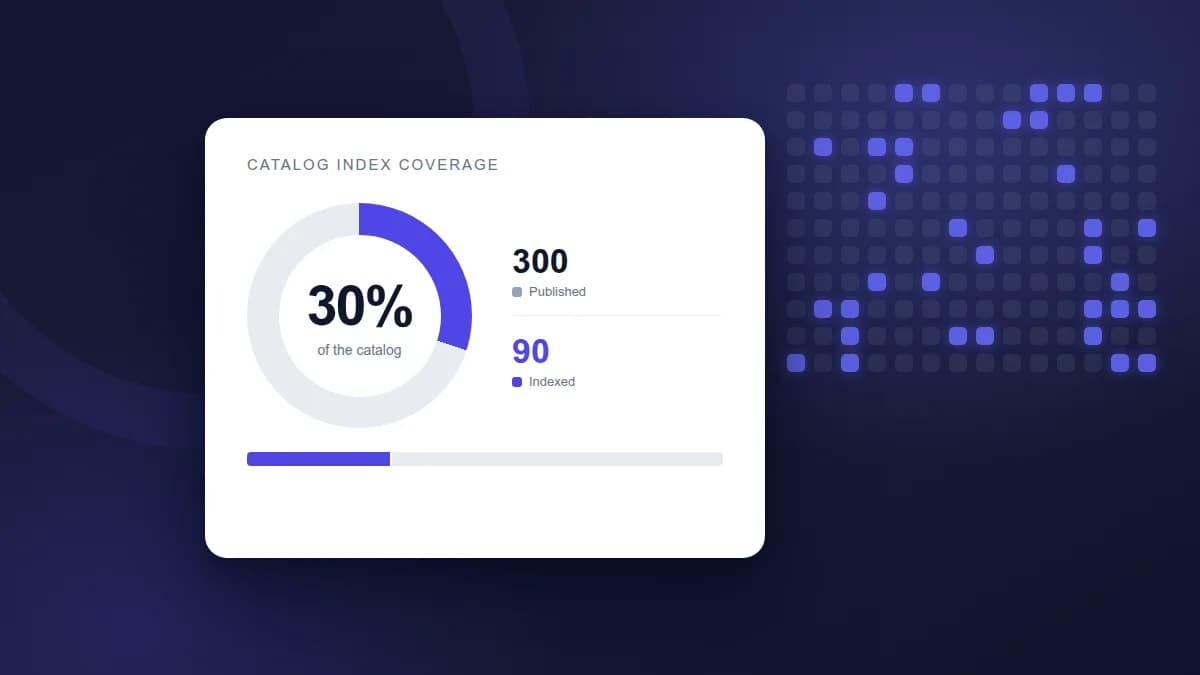
Traffic and rankings reveal only the best sellers. The metric that truly determines catalog SEO performance is coverage: how many products Google actually indexes.

Discover how product page user experience affects visibility on Google and AI search engines, with practical examples for WooCommerce stores.

Your site passes every speed test, yet your products do not appear on Google or in AI answers. Discover what your catalog is really missing.