
Fast Website but Products Invisible on Google? Here’s Why
Your site passes every speed test, yet your products do not appear on Google or in AI answers. Discover what your catalog is really missing.
Fast website but products invisible on Google: the problem no speed plugin can solve
A fast website with an invisible product catalog is a common situation: Core Web Vitals are green, but products do not rank on Google or get mentioned by AI search engines. This happens because speed measures the technical experience of a page, not the quality and structure of the information on each product page. That is what Google and AI systems evaluate when deciding what to display.
Many WooCommerce merchants invest in high-performance hosting and optimized themes, believing that this is enough to stand out. Meanwhile, competition is growing across several channels at once.

The myth to debunk: website speed does not equal catalog visibility
Page speed affects user experience and the site's overall ranking, but it says nothing about how clear, unique, or well-structured the content on each product page is.
Core Web Vitals and product SEO are two separate evaluation layers. The first concerns LCP, INP, and CLS: how quickly and stably a page loads. The second concerns what is written on that page: the title, description, attributes, and structured data. A site that loads in 1.2 seconds but uses supplier-copied descriptions gives Google nothing distinctive to display in response to a search.
Why this misleads merchantsPage speed tools such as PageSpeed Insights and GTmetrix return a reassuring performance score, which can make merchants think their SEO work is complete. In reality, that score does not measure the quality of titles or schema.org markup, or content uniqueness.
What Google and AI actually measure beyond Core Web Vitals
What counts is the semantic relevance of the text, the consistency between what a product claims and what the market is searching for, and, as confirmation, structured data such as Product schema.
For AEO, or answer engine optimization, engines read the page text together with the Product markup that WooCommerce already outputs. That markup helps confirm price and availability when it matches the page, and AggregateRating belongs only on products with real reviews. This applies to both Google AI Overviews and chatbots that browse the web in real time.
- A clear product title with distinctive attributes such as material, size, and use
- Unique descriptions that are not copied from suppliers or other marketplaces
- Correctly implemented schema.org Product markup
- Reviews and ratings, structured only if they reflect real customer reviews
- Categories that match search intent
A retailer sells handmade bathroom accessories on Etsy, eBay, and her own WooCommerce store. Her site scores well on PageSpeed, and her products use the same descriptions on every channel. Speed does not solve that: identical descriptions across channels make it harder for her own pages to stand out.
Product-level signals that speed does not cover
Every product needs its own signals: unique text, complete attributes, and alignment with real user questions, regardless of how quickly the page hosting it loads.
A WooCommerce product SEO score should consider the length and originality of the description, the presence of natural keywords connected to how the product is used, and image quality, including descriptive alt text. Website speed helps the user experience, but it is not a differentiating factor at the individual product-page level.
Multichannel duplication: the same description on Amazon, Etsy, and eBay
When the same text appears identically across marketplaces and on your own website, search engines tend to show only one of the versions, and it is not necessarily the one from your store.
Multichannel content duplication is one of the most overlooked problems for retailers who copy and paste the same description everywhere to save time. Google usually picks only one version to show, and it is not necessarily the one from their own site.
An illustrative example: a multichannel merchantA merchant runs a physical store and a WooCommerce shop with hundreds of products, along with sales on Amazon and Etsy. The merchant spends hours every day copying and adapting descriptions between channels, without a dedicated SEO team or enough time to check whether this work is producing measurable results.
An illustrative example: a jewelry maker on Vinted with her own websiteA jewelry maker produces resin jewelry and sells it through Vinted and her own WooCommerce store. She does not know which products actually have an SEO problem because she has never had an objective score to consult.
How to get four scores for every product: SEO, AI search, brand relevance, and completeness
An objective product score shows you exactly where to take action, without manually analyzing hundreds of product pages one by one.
Instead of relying on general impressions about the website, a merchant should be able to see four distinct dimensions for each product: traditional SEO strength; readability for AI search engines, or AEO; consistency with the brand's positioning; and completeness of the product data. This granular approach prevents you from wasting energy on generic fixes that do not address the products that actually need attention.
- Identify the products with the lowest scores
- Check whether product schema is present and correctly implemented
- Look for duplication across sales channels
- Rewrite content only where the score reveals a real gap
- Recheck after every change to measure improvement
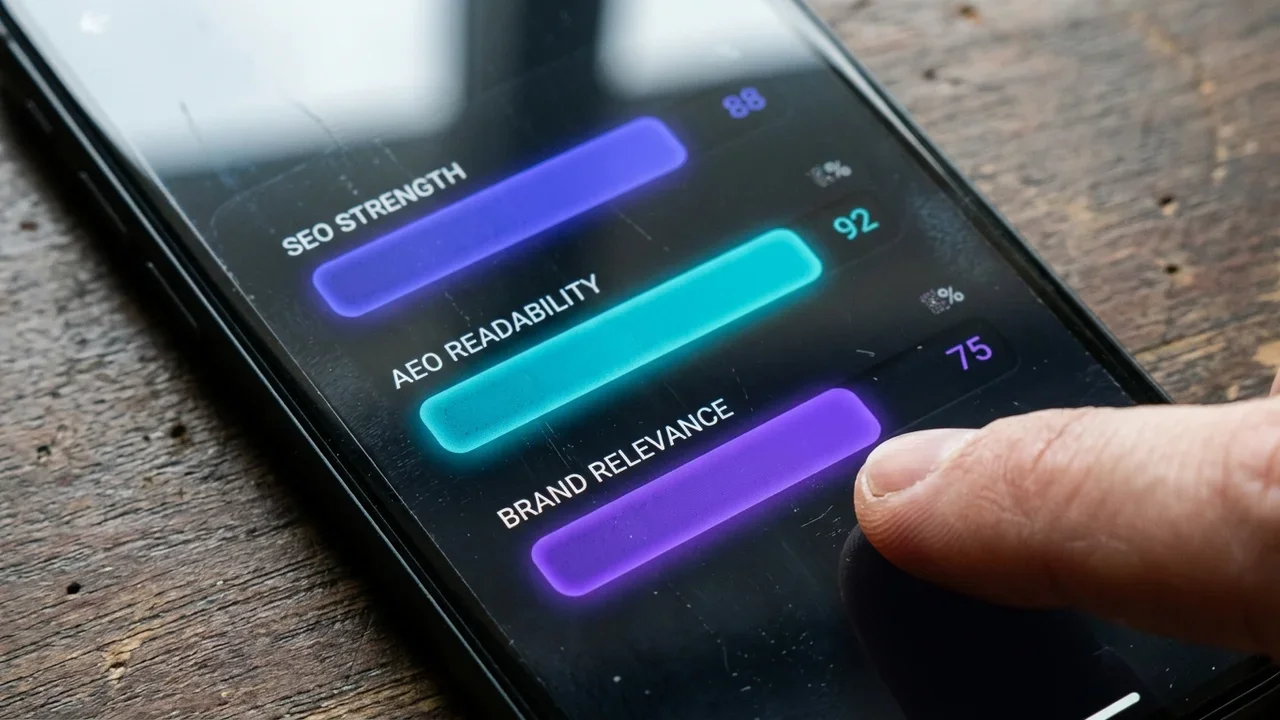
The practical action: a scan that reveals the real gap
Before changing any content, you need an objective snapshot of your catalog's current state to understand which products are genuinely limiting overall visibility.
An anonymous, read-only scan with no unrequested automatic changes provides that snapshot without putting the existing catalog at risk. It is the first step before making any decision about rewriting or correcting content.
What to look for in a useful scanA useful scan should provide a score that is easy to understand even without SEO expertise, identify the products that should be prioritized, and avoid changing anything without the merchant's explicit consent.
How Katapic shows what keeps a catalog out of sight
Katapic was created to address the exact gap between a high-performing website and a low-visibility catalog. Katapic assigns four scores to every product in the WooCommerce catalog (SEO, AI search, brand relevance and completeness), with a “Where to start” list sorted by impact, so a merchant knows what to do first. Katapic's automation always works with the product's real data: it does not invent specifications or replace the seller's judgment. The rewriting engine preserves the facts, while the initial scan remains anonymous and read-only, with no changes made without explicit consent. Anyone who wants to understand the current state of their catalog can start with a free Katapic scan.
Why Google and AI focus on what is writtenFor both traditional search engines and AI-powered conversational assistants, what counts is content that is clear, unique, and well structured with objective data, regardless of how quickly the page hosting it loads.
Common question: is speeding up my website enough to be found?No. Speed helps the user experience, but it is not enough on its own. You also need to improve the quality of each product's content, data structure, and consistency across sales channels. Otherwise, the site may be technically sound but struggle to be found in search results.
Does having my catalog on Amazon and Etsy hurt my website?It can if the texts are identical across all channels. You do not need to abandon multichannel selling, but you should differentiate the content so that each platform has a version recognizable as original, which makes it more likely that your store's version is the one shown.
Frequently asked questions about an invisible catalog despite a fast website
Why is my website fast but my products do not appear on Google?Speed is a technical factor related to the loading experience, while search visibility depends mainly on the quality, uniqueness, and structure of the content on each product page. A fast website with generic or duplicated descriptions remains uncompetitive in search results and AI-generated answers.
What is Product schema and why does it matter for AEO?Product schema is structured markup, specifically schema.org/Product, that communicates precise information about price and availability to search engines. WooCommerce already outputs a basic version, and AI search engines read it together with the page text. It helps confirm price and availability when it matches the page, AggregateRating belongs only on products with real reviews, and clear, consistent product data improves the chances of a product being cited in an AI response.
How can I tell whether my content is duplicated across channels?Compare the descriptions for the same product on Amazon, Etsy, eBay, and your own website. If the text is almost identical, it is likely that the search engine will show only one of the versions, not necessarily the one from your store. An automated catalog analysis makes this check faster for larger catalogs.
Is a product SEO score different from a general site SEO audit?Yes. A general audit evaluates the website as a whole, including speed, structure, and security. A product-level score analyzes each product page to identify which specific catalog entries require priority attention, without wasting effort on irrelevant fixes.
Do I need technical expertise to improve catalog visibility?No, not necessarily. Tools designed for merchants without an SEO background can provide clear guidance on what to fix without requiring complex configuration or development skills.
Frequently asked questions
- Why is my website fast but my products do not appear on Google?
- Speed concerns the loading experience, while search visibility depends on the quality and uniqueness of each product page's content. A fast website with generic descriptions remains uncompetitive in search results and AI answers.
- What is Product schema and why does it matter for AEO?
- It is structured markup that communicates precise information about price and availability to search engines. WooCommerce already outputs a basic version, and AI search engines read it together with the page text. It helps confirm price and availability when it matches the page, ratings belong in it only for products with real reviews, and clear, consistent product data improves the chances of being cited.
- How can I tell whether my content is duplicated across channels?
- Compare descriptions for the same product on Amazon, Etsy, eBay, and your own website. If the text is almost identical, it is likely that the search engine will show only one of the versions, not necessarily the one from your store.
- Is a product SEO score different from a general site SEO audit?
- Yes. A general audit evaluates the website as a whole, while a product-level score analyzes each product page to identify where action should be prioritized.
- Do I need technical expertise to improve catalog visibility?
- No. Tools designed for merchants without an SEO background can provide clear guidance without requiring complex configuration or development skills.